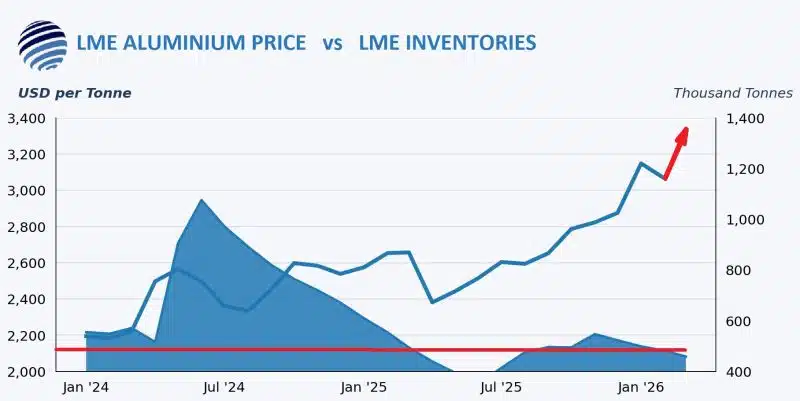
In the summer of 2025, Mercuria Energy Group surprised the global metals market with an unprecedented strategic move. The trading house, traditionally active in energy, occupied a dominant position on the London Metal Exchange (LME) and at its peak controlled more than 80% of all available aluminium stocks.
With a position of more than 426,000 tonnes of aluminium – accounting for almost 90% of LME stocks – Mercuria caused one of the largest concentrations in the history of the aluminium trade.
What drove Mercuria's aluminum position?
The position was based on a geopolitical investment view: the expectation that a possible peace agreement between Russia and Ukraine would lead to an easing of sanctions on Russian metals.
Of the stocks taken, approximately 228,000 tonnes were of Russian origin and the remainder mainly came from India.
In addition to physical stocks, Mercuria also built up significant long positions in LME futures contracts . This combination allowed the trading house to influence both the physical and financial markets – an approach that has rarely been carried out on such a large scale in metals trading.
Market distortions and price fluctuations
The coordinated strategy led to clear tensions in the market:
-
The cash-to-three-month spread shifted to strong backwardation – a situation in which direct delivery becomes more expensive than future deliveries.
-
This pricing structure made procurement planning difficult for industrial customers, especially in Asia, where regional premiums suddenly increased.
-
The physical cancellation of more than 100,000 tonnes of metal in Port Klang (Malaysia) led to shortages in the spot market and disrupted supply chains.
As Mercuria began tapering from late September, the market returned to contango, indicating a recovery in supply and easing tightness.
Intervention by the LME
The London Metal Exchange responded to the exceptional market dominance with emergency measures to protect market integrity.
The fair:
-
Strengthened rules on position concentration,
-
Obliged dominant parties to lend metal to other market players,
-
And introduced stricter limits on positions in short-term contracts.
This intervention highlights the tension between innovative trading strategies and ensuring a fair, transparent market.
Strategic repositioning
When geopolitical expectations shifted – partly due to harsh American statements about Ukrainian recapture plans – Mercuria quickly adapted its strategy.
The company sold a large part of the Russian metal and mainly retained non-Russian stocks, responding to changing market sentiments.
At the same time, Trafigura took over a large part of the vacant position, which made the market less dependent on one player, but still remained concentrated.
Structural Trends Behind the Movement
The Mercuria case reflects deeper developments in the aluminium world:
-
Chinese production caps are limiting global supply.
-
The energy transition is driving demand: electric vehicles contain 20–30% more aluminium than conventional cars.
-
High energy prices are squeezing smelters' margins and limiting producers' ability to expand.
These structural factors support the view that aluminium remains structurally scarce and strategically valuable .
Geopolitics as a New Price Factor
The Mercuria case shows how commodity markets are increasingly acting as geopolitical barometers.
The origin of metal – Russian or non-Russian – has now become a determining price factor, with self-imposed "consumption jobs" of Western buyers leading to origin premiums and discounts.
Transparency and oversight
The incident has revived the discussion about market transparency .
Although the LME publishes general data on position size, the names of holders are not mentioned. This creates information asymmetry between large trading houses and smaller industrial consumers.
Regulators and market participants are therefore calling for more openness about the positions and origin of metals, without undermining commercial strategies.
Conclusion
Mercuria's aluminum position marks a tipping point in global commodity trading.
It shows how:
-
markets are becoming increasingly intertwined, as well as
-
geopolitical expectations have a direct price impact,
-
and how large trading houses can steer market dynamics on a scale that was once unimaginable.
The episode highlights that aluminium – once a basic industrial raw material – has now also become a strategic financial instrument , in which trade, geopolitics and energy are inextricably linked.
By Muflih Hidayat - Discovery Alert